

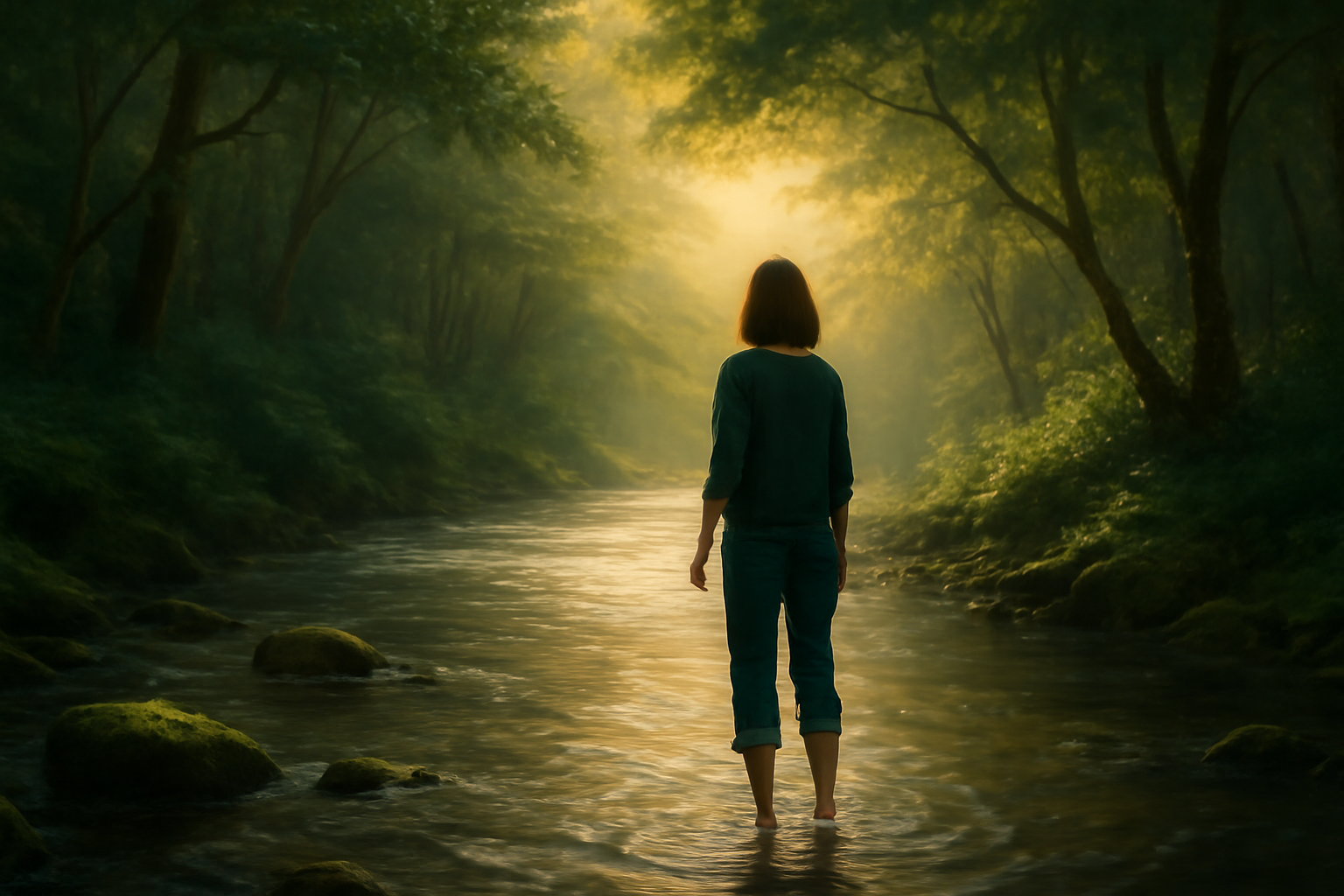
The river did not appear on any map.
From the sky, if satellites had bothered to look, it would have seemed like any other thin silver line threaded through forest and hill. But maps had a habit of only showing what could be measured.
And this river — the one that cut through the quiet valley behind the small town of Halden — couldn’t be measured in miles or meters.
It was measured in moments.
The locals called it, when they spoke of it at all, the Turning River.
Because, they said, if you found the right bend, and came at the right time, and stepped into the water with a question in your heart, the river would show you the exact moment your life turned toward joy.
Even if you didn’t know it yet.
Most people dismissed it as a story.
A nice one.
But still, a story.
Mina Hart didn’t come to Halden for magic.
She came because she didn’t know where else to go.
It had been a year of endings.
Her job — cut in a round of layoffs that came with apologetic emails and careful language about “restructuring.” Her long-term relationship — ended with a conversation that started with “I think we’ve grown apart” and ended with her key on the table.
And, worst of all, her father — gone in a quiet, breathless hospital room where the machines beeped and the air smelled like antiseptic.
He had always been the one who believed in unlikely things.
“You can always start over,” he’d say. “You’re never stuck. Not really.”
Mina had believed him when she was little.
Now, at thirty-three, sitting in her tiny apartment surrounded by boxes she couldn’t bring herself to unpack, she felt stuck in the deepest way.
She needed space.
Time.
Silence.
So when a friend offered her the use of a small rented cottage in Halden for a few months — “Just to get away, reset, breathe a bit” — she said yes.
Not because she believed anything would change.
But because she couldn’t keep living in the ruins of what her life had been.
Halden was the kind of town that felt like it existed slightly out of time.
One main street lined with brick-front shops: a bakery that smelled of cinnamon and butter, a hardware store that sold everything from nails to knitted socks, a secondhand bookshop with ivy climbing its windows.
The cottage was small, crooked, and perfect. It creaked when she walked, sighed when the wind pressed against its shutters, and let in more sunlight than her city place ever had.
Outside, hills rolled gently into a dark fringe of trees.
Beyond that, people said, ran the river.
Mina only learned about its reputation in passing.
On her second morning, she stopped at the bakery, and the woman behind the counter — late fifties, sharp eyes, flour on her sleeves — asked, “You’re the one staying in the Hartley cottage?”
“Yes,” Mina said. “Just for a while.”
“Good place to think,” the woman said. “Or stop thinking, if you’re any good at that.” She slid a cinnamon roll into a bag, then added a second. “On the house. First-timer tax.”
“Thank you,” Mina said, surprised at the kindness. “It’s… beautiful here.”
“Mm. Have you walked to the river yet?”
Mina shook her head.
The woman’s eyes crinkled.
“People say it shows you things,” she said. “If you’re willing to get your feet wet.”
“What kind of things?” Mina asked.
“Depends what you need,” the woman replied. “But most say it shows you the moment your life turns toward joy.”
Mina almost laughed.
“Does it show you when it turns away from it?” she asked, more bitterly than she meant to.
The woman’s gaze softened.
“We don’t need help finding those moments,” she said gently. “We carry them easily enough.”
She tapped the counter with two fingers.
“When you’re ready, take the west path past the big oak. You’ll hear it before you see it.”
Mina tucked that away in the part of her mind where she kept things she wasn’t sure she believed but didn’t want to forget.
It took her a week to go.
She filled the days with aimless walks, half-finished journal entries, and long, quiet cups of coffee by the cottage window.
Grief sat with her like an uninvited guest.
Sometimes it was loud, demanding attention.
Sometimes it was just… heavy.
She woke one morning to birds arguing in the hedge and felt something small and stubborn stir in her chest.
A question.
What if that story is true?
By midafternoon, she couldn’t shake it.
She laced up her boots, shrugged on a jacket, and stepped outside.
The west path was easy to find — a streak of trodden earth cutting through tall grass, leading toward the tree line. The big oak was impossible to miss, its branches twisting skyward like a question mark.
Beyond it, she listened.
And then she heard it.
Water.
Not the crashing roar of mountain rapids.
A low, steady rushing. A constant murmur.
She followed the sound.
The trees grew closer together, leaves knitting a dappled canopy overhead. The air cooled, damp and green. The earth softened under her feet.
And then, suddenly, the trees parted.
The river lay before her.
It was neither wide nor narrow, neither fast nor slow. It moved with a graceful inevitability, its surface broken here and there by moss-slick rocks. Sunlight scattered in fractured paths across it.
For a long moment, Mina just stood there.
She felt… nothing special.
No mystical tingle.
No thunderclap of revelation.
Just the ordinary beauty of water in motion.
She almost turned back.
“This is silly,” she muttered. “It’s a river.”
The river did not argue.
It just kept flowing.
Mina stepped closer. Pebbles crunched under her soles.
What was it the baker had said?
If you’re willing to get your feet wet.
Mina stared at the water.
“What would you even show me?” she asked it quietly. “That I already ruined everything? That the best parts are behind me?”
The grief in her chest tightened.
She could list the turning-away moments easily.
The day her father’s diagnosis came.
The day the email about layoffs landed in her inbox.
The night her partner said “I think we want different things” and she realized they were right.
She hugged herself.
“I don’t know if I can handle more bad news,” she whispered.
The river’s surface shimmered in the light.
Something in its steady, unbothered motion calmed her.
The water didn’t rush.
It didn’t strain.
It just moved forward.
Mina toed off her boots.
The stones were cool under her bare feet. She rolled up her jeans and stepped forward until her toes met the water.
It was colder than she expected.
But not unpleasant.
Like the shock of a deep breath.
She waded in until the river hugged her ankles, then her shins.
The current tugged gently at her, as if checking she was really there.
“Okay,” she whispered, voice shaking. “If you’re real… show me.”
The sound of the river grew louder.
Or maybe everything else grew quiet.
The trees blurred. The light softened.
The world tilted—
—and her reflection on the water’s surface shifted.
She was no longer seeing herself as she was.
She was seeing herself as she had been.
Mina stood in the middle of a scene that unfolded not in front of her, but around her, as if the river had pulled her down into a memory layered under reality.
She was in a kitchen.
Not the cottage.
Her childhood home.
She recognized the faded yellow cabinets, the jam stain on the corner of the table. The hum of the old refrigerator.
Her father stood by the stove, stirring something in a pot. He was younger — less gray, shoulders broader. He wore the apron she’d bought him one Father’s Day that said “Chief of the Mess Hall.”
On the floor, a girl of about eight sat cross-legged, a stack of paper and crayons scattered around her.
Mina.
Little Mina was drawing with fierce concentration. A dragon with crooked wings. A castle on a hill. Stars everywhere.
Her father glanced down, smiled.
“Busy, bean?”
“I’m working,” little Mina said gravely.
“Ah,” he replied. “Same.”
She held up her drawing.
“Do you like it?”
He leaned down, giving it the full weight of his attention.
“I love it,” he said. “Tell me about it.”
Mina watched as her younger self lit up.
“It’s a dragon who doesn’t want to be scary,” she said. “So he learns to draw nice pictures instead of breathing fire.”
Her father laughed.
“That’s very specific.”
“He wants people to know he’s nice,” little Mina insisted. “But they only see the teeth. So he makes art.”
Mina felt tears prick her eyes.
She didn’t remember this. Not clearly.
But the river did.
Her father knelt to her eye level.
“You know what I see when I look at you drawing like that?” he asked.
“A mess?” little Mina guessed.
“A storyteller,” he replied. “Someone who’s going to make things that help people feel less alone.”
Little Mina blinked.
“Really?”
“Really,” he said. “You have something special, kiddo. Promise me you won’t forget that, okay?”
She nodded solemnly.
“I promise.”
The kitchen blurred.
Mina felt the river’s current tug gently at her legs.
The scene dissolved.
Another took its place.
This time, she was older — twenty-two, maybe — sitting in a lecture hall with a portfolio in her lap, stomach knotted with anxiety.
She recognized the moment instantly.
Her final critique in art school. The one where a professor’s sharp comment had cut so deeply it had taken years to unclench from it.
But the river was showing her something slightly different than her memory.
She remembered the embarrassment, the sting, the way she’d focused on the one negative phrase: “Too sentimental. The world doesn’t want soft.”
What she hadn’t remembered — or had refused to hold onto — was what happened afterward.
The scene shifted to the hallway outside the classroom.
She saw herself leaning against the wall, blinking back angry tears.
She saw another student — a girl with a sketchbook tucked under her arm — approach her.
“I loved your piece,” the girl said. “The one with the grandmother and the garden. It made me cry. In a good way.”
Mina, younger, shook her head.
“He hated it.”
“He’s one person,” the girl replied. “He makes good points sometimes, but he’s wrong about the world not wanting soft. I want soft. I want exactly what you made.”
The river wrapped that sentence in warmth.
I want soft. I want exactly what you made.
The memory softened and slipped away.
The next scene was not from years ago.
It was from… recently.
Mina stood in the doorway of her father’s hospital room, watching him sleep. Machines beeped quietly. A vase of flowers drooped on the windowsill.
She remembered the heaviness.
The fear.
But the river added a layer she’d almost discarded.
Her father woke, saw her, and smiled.
“There you are,” he whispered.
“Where else would I be?” she said.
“I was afraid you’d feel like you had to stay away,” he murmured. “To spare yourself.”
She shook her head.
“I’d rather hurt with you than be fine without you,” she said, voice shaking.
He reached out, squeezed her hand.
“I’m proud of you,” he said. “Not because of work or… any of that. Because you keep loving even when it scares you.”
Tears spilled down both their faces.
The memory dimmed.
Mina found herself back in the river.
The water flowed around her ankles, steady and cool.
Her chest hurt.
But something inside it had loosened.
“Those aren’t moments when my life turned toward joy,” she whispered. “Those are just… memories. And most of them hurt.”
The river whispered against the stones.
Not yet, it seemed to say.
Not the one.
The light shifted.
One more scene rose from the water.
Mina braced herself.
It was… the cottage.
The same one she was staying in now. But this version was bathed in late-afternoon sunlight, long shadows stretching across a table strewn with papers.
Older Mina — a version a few years beyond where she stood now — sat at that table, pen moving steadily across a page. Her expression was focused, soft. When she paused, she looked… content.
Content in a way Mina had almost forgotten was possible.
The camera of the vision (if it could be called that) panned slowly around the room.
On the wall hung several framed prints — illustrations in a style she recognized as her own, but freer, bolder.
On the table, beside the papers, was a copy of a book.
Her name on the cover.
A knock sounded at the door.
Future Mina stood, stretching, and opened it.
A small group of people stood outside — three women, a teenage boy, an older man. All held copies of the book. Their faces were shy, emotional.
“Hi,” one of them said. “We’re so sorry to bother you at home. We just… heard you sometimes sign copies here. Your stories… helped us. We wanted to say thank you.”
Future Mina’s eyes shone.
“Come in,” she said. “Please.”
The image froze on her face.
That expression.
Not ecstatic.
Not euphoric.
But deeply, quietly joyful.
At home in herself and in what she offered the world.
The river brightened around Mina, like someone had poured light into the water.
“This,” she breathed. “This is the moment?”
The scene flickered.
Shifted.
Now it showed her, current-her, standing on the bank of the river.
Barefoot. Soaked to the knees.
Grief in her eyes.
And also—
Something else.
The faintest spark of believing that more could exist than the pain she’d known.
“This?” she whispered, stunned. “Now?”
The river surged around her ankles, gentle but insistent.
Yes.
She frowned, tears spilling.
“My life doesn’t feel like it’s turning toward joy,” she said. “It feels… suspended. Empty.”
But as she said it, she knew it wasn’t true.
She was here.
She had stepped outside the pattern she’d been stuck in.
She had dared to ask for something she wasn’t even sure she believed in.
She had let herself be shown not just the hurt, but the threads of love and kindness and possibility woven through it.
“What if I don’t know how to get from here to there?” she asked the river. “To that table. That book. That… version of me.”
The water flowed.
Over stones.
Around obstacles.
Always forward.
A word rose in her mind, clear as spoken language.
Gently.
The second word came on the next swirl.
Honestly.
Then:
Together.
She thought of the people in the doorway of future-her’s cottage. Of the student in the hallway who had loved her art. Of the baker who had given her two cinnamon rolls “on the house.”
Of her father, calling her a storyteller.
Maybe the river wasn’t promising a miracle.
Maybe it was showing that joy didn’t arrive all at once, in a blaze. It built itself slowly from small brave things.
Sitting down to write one page.
Sending one message.
Letting one person see her as she truly was.
Letting herself see herself.
Mina laughed through a sob.
“That’s it, isn’t it?” she said. “This moment turns toward joy because I stop pretending it’s impossible.”
The river sparkled, pleased.
She stayed there until her legs went numb from the cold and her heart felt less like a locked room and more like a field after rain — messy, tender, ready for new growth.
When she finally stepped back onto the bank and pulled on her boots, the world felt different.
No less uncertain.
No less full of grief for what she’d lost.
But tilted.
Just a little.
Toward something kinder.
On her way back through town, she stopped at the bakery.
The bell chimed as she entered.
The woman behind the counter looked up, assessing her damp jeans, her flushed cheeks, her red eyes — and smiled like she knew exactly where Mina had been.
“Well?” she asked, sliding a fresh cinnamon roll onto a plate. “Did the river show you anything good?”
Mina thought of the kitchen with her father. The art school hallway. The book in her older self’s hands. The people at the door saying, Your stories helped us.
She thought of herself standing in the water, finally ready to believe that joy might still be possible.
“Yes,” Mina said, voice steady. “I think it did.”
The woman nodded.
“Then you’ll be all right,” she said simply. “Might be hard. Might take time. But you’re pointed the right way now.”
Mina sat at a small table, pulled a notebook from her bag, uncapped a pen.
The page stared up at her.
For a moment, the old fear flared.
What if it’s bad? What if no one cares? What if you’re not good enough?
She thought of the river.
One line at a time.
One turn at a time.
She put pen to paper.
And began to write the first paragraph of the story that would one day bring strangers to her door, books in their hands, gratitude in their eyes.
She didn’t know that yet.
She just knew it felt, for the first time in a long time, like she was moving.
Slowly.
Carefully.
But undeniably.
Toward joy.